«Gender-based Violence on Social Media» Series
Action 5.9 in the Gender Equality Plan of the Parliament of Catalonia envisages the development of a comprehensive strategy to provide an institutional response to situations of gender-based violence suffered by female Members of Parliament on social media. Against that background, the Parliament has organised a series of talks looking at gender-based violence on social media from an intersectional approach. The series examines the impact of gender-based violence on all publicly prominent women, ranging from elected officials to activists and journalists.
The goal of the series is to provide a mechanism for raising awareness and highlighting the situations of gender-based violence faced by high-profile women on social media. At the same time, it is hoped to identify and gather together examples of best practice so that such best practice can become an institutional commitment that can be shared by parliamentary groups and parties.
Guided by those goals, a minimum of four round-table sessions will be held to address several key aspects enabling the identification, by the end of the series, of the best practices to be included in the institutional commitment.
The sessions will feature participants with expertise in the topic for discussion in each session, whether that expertise be technical, activist, or institutional, without overlooking the European sphere.
Session 3
«Digital Gender-Based Violence: Legal Tools and Public Policies»
9 December 2025 – 6 p.m.
Auditorium, Parliament of Catalonia.
There will be interpreting in Catalan, English and Catalan Sign Language.
Programme
6 p.m. Opening.
Welcome by Ms Raquel Sans Guerra, First Vice President of the Parliament of Catalonia.
Start of the round-table, moderated by Ms Laura Martínez Portell, Member of Parliament, rapporteur of the session and member of the Working Group on Gender Equity, Anti-Racism and Non-Discrimination.
Contributions from:
- Dr Nadine Gasman Zylbermann, Secretary of Health of Mexico City, former President of the National Institute for Women in Mexico, and former Deputy Director for Latin America and the Caribbean for the United Nations campaign to end violence against women (pre-recorded)
- Dr Maria Barcons Campmajó, lecturer in philosophy of law and researcher at the Antígona research group in the Faculty of Law of the Autonomous University of Barcelona
- Ms Zita Gurmai, Hungarian Socialist Party Member of Parliament, member of the Equality and Non-Discrimination Committee of the Parliamentary Assembly of the Council of Europe, and rapporteur on the report Promoting the Istanbul Convention and improving its implementation: building on lessons learnt
- Dr Patsilí Toledo Vásquez, international consultant on women's human rights and member of the United Nations' Committee on the Elimination of Discrimination against Women
7.30 p.m. Closing.
Panellist biographies
- Nadine Gasman Zylbermann, Secretary of Health of Mexico City, former President of the National Institute for Women in Mexico, and former Deputy Director for Latin America and the Caribbean of the United Nations campaign to end violence against women.
- Maria Barcons Campmajó, lecturer in philosophy of law and researcher at the Antígona research group in the Faculty of Law of the Autonomous University of Barcelona. Doctor of Law, political scientist and Master’s Degree in Gender Studies. She has participated in projects concerning, and published on, digital violence against women. Author of the report Violència masclista digital: anàlisi de l'atenció i resposta a les víctimes des d'una perspectiva de gènere i propostes de millora («Digital Gender-Based Violence: Analysis of Victim Support and Response from a Gender Perspective and Proposals for Improvement», 2024).
- Patsilí Toledo Vásquez, international consultant on women's human rights and member of the United Nations' Committee on the Elimination of Discrimination against Women. Doctor of Public Law and Associate Professor of Gender and the Criminal Justice System (Criminology) and Gender Violence and International Protection of Human Rights (Barcelona Programme for Interdisciplinary Studies).
- Zita Gurmai, member of the Hungarian Socialist Party, member of the Equality and Non-Discrimination Committee of the Parliamentary Assembly of the Council of Europe (PACE). Rapporteur on the reports Promoting the Istanbul Convention and improving its implementation: building on lessons learnt, and Paving the way for a culture of consent. Throughout her career, she has been committed to the promotion of gender equality and women's rights, at national and international levels, in political parties and through civil society initiatives. She was a member of the European Parliament from 2004 to 2014, serving on committees focusing on women's rights, gender equality and regional development. In PACE, she was general rapporteur on violence against women from 2020 to 2022 and she has submitted to the Assembly several reports on progress and challenges in the implementation of the Istanbul Convention.
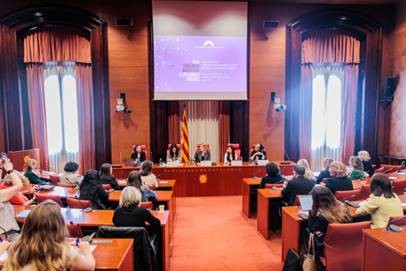
Session 2
«Digital Gender-based Violence Against High-Profile Women»
13 May 2025 – 6 p.m.
Parliament of Catalonia.
Programme
6 p.m. Opening.
Opening remarks by Ms Raquel Sans i Guerra, First Vice-President of the Parliament of Catalonia (from the lectern).
Start of the round-table, moderated by Ms Elena Díaz Torrevejano, Member of Parliament, rapporteur of the session and member of the Gender Equity, Anti-Racism and Non-Discrimination Working Group of the Parliament of Catalonia, with contributions from:
- Ms Sara González Muñoz, journalist and president of the Col·lectiu Ciutadella - Associació de Periodistes Parlamentaris de Catalunya (Ciutadella Collective)
- Ms Paulina Gutiérrez Ramírez, director of the Civic Space Programme at Article 19 (in Spanish)
- Ms Míriam Hatibi Zagmal, feminist and anti-racism activist and communication consultant
Summing up by Ms Elena Díaz Torrevejano, Member of Parliament, rapporteur of the session and member of the Working Group on Gender Equity, Anti-Racism and Non-Discrimination.
7.15 p.m. Closing.
Panellist biographies
- Sara González Muñoz, journalist and president of the Ciutadella Collective - Association of Political Journalists of Catalonia. She is a politics editor at El Periódico de Catalunya; a political analyst on several radio and television outlets; author of the books Per raó d’Estat [For reasons of state] (Ara Llibres), Cas Mercuri, la galàxia Bustos [Mercury Case, the Bustos galaxy] (Saldonar) and El part dels comuns [The Commom Party Birth] (Saldonar), and a board member of the Ramon Barnils Group of Journalists.
- Paulina Gutiérrez Ramírez, director of the Civic Space Programme at Article 19, an international organisation that defends freedom of expression and information. She is an international human rights lawyer, senior technology and digital services public policy advisor; expert in freedom of expression and the intersection of technology, gender and non-discrimination. She has over fifteen years’ experience as a litigator and of the development of progressive standards and public policies relating to freedom of expression, privacy, gender and non-discrimination at the regional, national and international levels.
- Míriam Hatibi Zagmal, feminist and antiracism activist and communication consultant. With a first degree in International Business Economics from Pompeu Fabra University and a postgraduate degree in internationalisation from the University of Barcelona, she currently works in a communications agency that specialises in social media data mining. She has been a spokesperson for the Ibn Battuta Foundation, whose mission is to foster sociocultural exchange and the flow of scientific knowledge between Morocco and Spain.
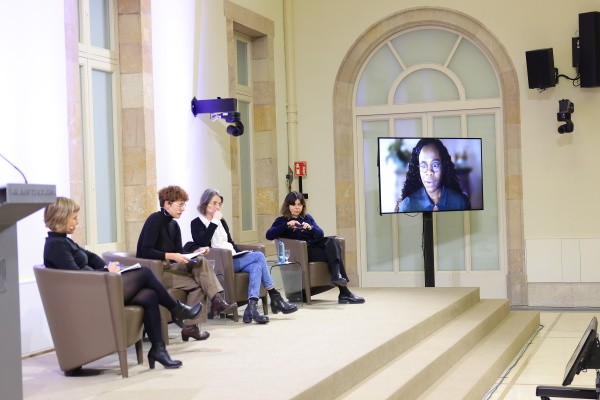
Session 1
«Social Media: A Participatory Public Space»
11 January 2024 – 6 p.m.
Auditorium, Parliament of Catalonia.
The event will have interpreting in Catalan, English, and Catalan Sign Language.
Programme
6 p.m. Opening.
Opening remarks by Ms Anna Erra i Solà, President of the Parliament of Catalonia.
Start of the round-table, moderated by Ms Jenn Díaz, Member of Parliament, rapporteur of the session and member of the Gender Equity, Anti-Racism and Non-Discrimination Working Group of the Parliament of Catalonia, with contributions from:
- Ms Asha Allen, director of the Online Expression and Civic Space Programme at the European office of the Centre for Democracy and Technology
- Ms Eva Cruells López, helpline and support service for digital gender-based violence coordinator at Fembloc
- Ms Laia Serra Perelló, criminal lawyer who specialises in strategic litigation relating to digital violence and hate speech
- Ms Eugenia Siapera, professor of Information and Communication Studies at University College Dublin
Summing up by Ms Jenn Díaz, Member of Parliament, rapporteur of the session and member of the Working Group on Gender Equity of the Parliament of Catalonia.
7.30 p.m. Closing.
Panellist biographies
- Asha Allen, of the online expression and civic space programme at the European office of the Centre for Democracy and Technology, a non-for-profit which advocates for human rights in EU technology policy.
She coordinates responses in relation to free expression, content moderation, the responsibilities of social media platforms and the protection of fundamental rights in the online civic space. She is a specialist in policies for the eradication of online gender-based violence, which have been nominated for various awards; she is a member of the «Who Writes the Rules» campaign. Advocates for the meaningful participation of marginalised groups in the decision-making processes of the European Union. - Eva Cruells López, coordinator of Fembloc, a helpline and support service for digital gender-based violence.
Eva Cruells is a psychologist and has a master's degree in public and social policy. Co-founder of the cyberfeminist collective Dones Tech [Tech Women] and project manager at Alia - Association of Women for Research and Action; she is a researcher and consultant on gender equality policies and an expert in the field of gender-based violence, with a particular focus on digital gender-based violence. - Laia Serra Perelló, criminal lawyer and expert in strategic litigation relating to digital violence and hate speech.
Laia Serra advised on the committee stages of Act 17/2020, amending Act 5/2008, on the right of women to eradicate gender-based violence, supporting the inclusion of digital gender-based violence in the Act. She is the author of the studies «Les violències de gènere en línia» [Online gender-based violence] and «Discurs d’incitació a l’odi: anàlisi des dels drets humans i pautes interpretatives» [Hate speech:an analysis of human rights and intepretative frameworks], both published in 2018; and co-author of the Generalitat Police Force - Mossos d'Esquadra’s manual Violències masclistes digitals: Quines són i què hi podem fer? [Digital gender-based violence: What is it and what can we do about it?]; co-researcher at Fembloc, European project concerning digital violence 2020-2022, and co-researcher of the Handbook on the impact of digital gender-based violence, 2023. - Eugenia Siapera, professor of Information and Communication Studies at University College Dublin, where she is also director of the Centre for Digital Policy (with Elizabeth Farries).
Her research interests focus on the field of digital technologies and social justice. She has written extensively on topics such as platform governance, digital racism, online misogyny and the digital far-right. She is the co-editor of Gender Hate Online: Understanding the New Anti-Feminism (Palgrave, 2019, with Debbie Ging) and is currently working on the third edition of her book Understanding New Media (Sage).
Other sessions
- Session 4. Digital Gender-based Violence: party contributions, date to be confirmed.